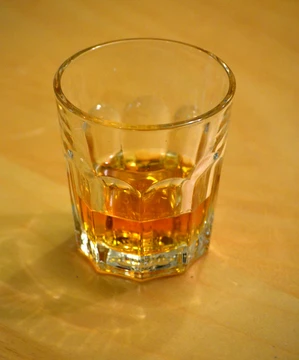
Tennessee whiskey
Tennessee whiskey is straight whiskey produced only in Tennessee.

Tennessee whiskey is straight whiskey produced in the U.S. state of Tennessee. Although it has been legally defined as a bourbon whiskey in some international trade agreements, most current producers disclaim references to their products as 'bourbon' and do not label them as such. All current Tennessee whiskey producers are required by Tennessee law to produce their whiskeys in Tennessee and – with the sole exception of Benjamin Prichard's – to use a filtering step known as the Lincoln County Process prior to aging. Tennessee whiskey is one of the top ten exports of Tennessee, and as of 2013, the U.S. market for bourbon and Tennessee whiskey reached $2.4 billion, with exports exceeding $1 billion.
- origin
- Tennessee, United States
- legal_definition
- Straight bourbon whiskey produced only in Tennessee under NAFTA and other trade agreements
- key_requirement
- Lincoln County Process (maple charcoal filtering) except for Benjamin Prichard's
- major_producers
- Jack Daniel's (Brown-Forman), George Dickel (Diageo)
- exports_value_2013
- Over $1 billion
- state_law_enacted
- May 13, 2013
Lore & Background
Whiskey production in Tennessee began with the emigration of Scotch-Irish from Pennsylvania and Virginia. President Andrew Jackson served Tennessee whiskey in the White House, a custom continued by James Polk. By the end of the 19th century, there were over 700 licensed distilleries in the state. After repeal in 1933, Jack Daniel's moved operations back to Lynchburg as the first distillery to open post-Prohibition. George Dickel followed in 1958 as a revived brand. The Lincoln County Process involves filtering whiskey through a thick layer of maple charcoal before aging in new charred oak barrels. Ironically, the only whiskey currently produced within Lincoln County is Prichard's, which does not use the process. The law contains a specific exception for Benjamin Prichard's. Jack Daniel's supported the legislation; some smaller distilleries opposed it. In 2014, legislation was introduced to allow reuse of barrels, which Diageo supported and Jack Daniel's opposed.
Reader's Guide
Tennessee whiskey holds significance as a distinct American whiskey category, legally defined both internationally and by state law. Its production is concentrated among two major producers—Jack Daniel's and George Dickel—along with numerous smaller distilleries. The 2013 state law codified the Lincoln County Process as a defining characteristic, setting Tennessee whiskey apart from bourbon despite their near-identical requirements. This legal distinction has marketing value, as most producers disclaim the bourbon label. As of 2013, many Tennessee counties still prohibit alcohol sales. A 2009 amendment to state law expanded the number of counties where distilleries could be established from three to 41 additional counties, expected to increase the number of producers. The Tennessee Whiskey Trail, launched in June 2017 by the Tennessee Distillers Guild, is a 25-stop distillery tour promoting Tennessee whiskey and local whiskey culture. The category remains economically important, with exports exceeding $1 billion as of 2013.
Did You Know?
- Tennessee whiskey is legally defined as a straight bourbon whiskey under NAFTA and other international trade agreements.
- The Lincoln County Process is named for Lincoln County, Tennessee, but the only whiskey currently produced within that county is Benjamin Prichard's, which does not use the process.
- As of 2013, many Tennessee counties still prohibit the sale of alcohol.
Linguistic Roots: The Water of Life
The name we use for this spirit carries a story stretching back to the ancient Celtic languages. At its core, the word derives from the Classical Gaelic uisce (or uisge), a simple term meaning "water." This root is not isolated; it shares a deep linguistic ancestry with the Germanic word for water and the Slavic voda, all pointing to the same primordial concept. The spirit itself was known in Latin as aqua vitae, literally "water of life," a phrase that captured the alchemical belief in distilled alcohol's restorative power. That Latin expression was rendered into Middle Irish as uisce betha, which evolved over centuries into uisce beatha in Irish and uisge beatha in Scottish Gaelic. As the word crossed into English, it shed its formal structure and took on a string of phonetic approximations: uskebeaghe in 1581, usquebaugh by 1610, usquebath in 1621, and usquebae as late as 1715. Each spelling is a fossil of a listener trying to capture a Gaelic pronunciation in an English alphabet, a small window into how the spirit traveled between cultures and centuries.
The Spelling Divide
One of the most persistent debates surrounding this spirit is whether to write it with an "e" or without. Two schools of thought dominate the conversation. The first treats the difference as purely a matter of regional convention, no different from the split between "color" and "colour" in English. The second insists the spelling should reflect the style or geographic origin of the particular spirit being described. In practice, whiskey with the "e" is the standard in Ireland and the United States, while every other whisky-producing nation uses the shorter form. American usage was far from settled for centuries; from the late 1700s through the mid-1900s, publications in the US swapped between both spellings with little consistency. It was the introduction of newspaper style guides that began to standardize the practice. Since the 1960s, American writers have generally adopted whiskey for domestically produced spirits and reserved whisky for those made abroad. Yet the convention is not absolute: prominent US brands such as George Dickel, Maker's Mark, and Old Forester all print the "whisky" spelling on their labels, and the federal Standards of Identity for Distilled Spirits use that same spelling throughout their legal text.
From Alchemy to Apothecary: The Medieval Roots
The story of distilled spirits begins in a world of uncertainty and slow transmission. Some scholars have speculated that Babylonians in Mesopotamia may have practiced distillation as far back as the second millennium BC, though the evidence remains disputed. The earliest confirmed chemical distillations belong to Greek practitioners in Alexandria during the first century AD, but they were working with perfumes and aromatics, not alcohol. Medieval Arab scholars adopted the Alexandrian technique, and written records in Arabic appear from the ninth century, yet again without alcohol distillation. The technology eventually reached medieval Latin Europe, with the earliest records dating to the early twelfth century. The true breakthrough for our subject came in thirteenth-century Italy, where alcohol was first distilled from wine; the Catalan polymath Ramon Llull provided one of the earliest descriptions of the method. From there, the practice spread through monasteries, where monks used the spirit primarily as medicine for ailments like colic and smallpox. Distillation reached Ireland by the twelfth century and Scotland by the fifteenth, eventually passing from the monastic setting into the hands of the Guild of Barber-Surgeons, the professional medical practitioners of the era.
Smoke and Shadows: The Age of the Malt Tax
The eighteenth century brought a dramatic and often clandestine chapter to the history of distilled spirits in Scotland. When the Acts of Union in 1707 merged England and Scotland into the Kingdom of Great Britain, the new government imposed sharply higher taxes on distilled spirits. The situation worsened with parliament's divisive malt tax of 1725, which effectively drove most of Scotland's legal distillation underground. What followed was an era of ingenuity and defiance: whisky was concealed beneath church altars, tucked into coffins, and stashed in any crevice a distiller could find, all to evade the government excisemen known as revenuers. Operating from homemade stills, Scottish distillers shifted their work to the dead of night, when darkness masked the telltale smoke rising from their equipment. At the height of this shadow economy, it was estimated that more than half of all whisky produced in Scotland was entirely illegal. The spirit that would later become a globally celebrated category was, for a generation, a product of secrecy, risk, and the simple human refusal to let a tax extinguish a tradition.
Common Misconceptions (Editorial)
- A common misconception is that Tennessee whiskey and bourbon are entirely separate categories, but under NAFTA and other international trade agreements, Tennessee whiskey is legally defined as a straight bourbon whiskey. - Another misconception is that all Tennessee whiskeys use the Lincoln County Process; in fact, Benjamin Prichard's is legally exempt from this requirement. - Some believe the Lincoln County Process is still performed in Lincoln County, but the only whiskey currently produced in Lincoln County is Prichard's, which does not use the process.
Why It Matters (Editorial)
Tennessee whiskey matters not only as a major export worth over $1 billion annually, but as a cultural touchstone rooted in the state's Scotch-Irish heritage and presidential history. Its legal codification in 2013 highlights ongoing tensions between tradition—exemplified by the Lincoln County Process—and modern commercial interests, making it a case study in how local identity shapes global markets.
Frequently Asked Questions
Who is Tennessee whiskey?
Tennessee whiskey is a straight whiskey crafted exclusively within the borders of Tennessee, United States. Although international trade pacts like NAFTA slot it into the bourbon category, the state's own producers firmly reject the bourbon label on their bottles.
What are Tennessee whiskey's signature powers?
Its defining ability is the Lincoln County Process, a maple-charcoal filtration step performed before the spirit ever touches oak. Tennessee state law mandates this filtering for every producer, with Benjamin Prichard's being the single named exception.
How was Tennessee whiskey's origin story officially written?
The state codified its production rules into law on May 13, 2013, locking in both the in-state manufacturing requirement and the charcoal-filtering mandate. That legislative act gave the category a formal legal identity separate from generic bourbon.
Why is Tennessee whiskey so important to the world?
It consistently ranks among Tennessee's top ten exports, pulling in more than a billion dollars in revenue by 2013. Flagship brands such as Jack Daniel's (Brown-Forman) and George Dickel (Diageo) carry the name to bars and shelves worldwide.
What's the real difference between Tennessee whiskey and bourbon?
The practical gap is that Tennessee whiskey must pass through maple charcoal before aging, a step bourbon never requires. Beyond that, producers in Tennessee deliberately distance their branding from the word 'bourbon' even when trade agreements insist on the classification.
More in World of Whisky 1-20
Spotted an error? Know more?
This is a living reference — every entry is fact-audited, and reader corrections feed straight into our audit queue. Suggest an edit · See this site's audit record